
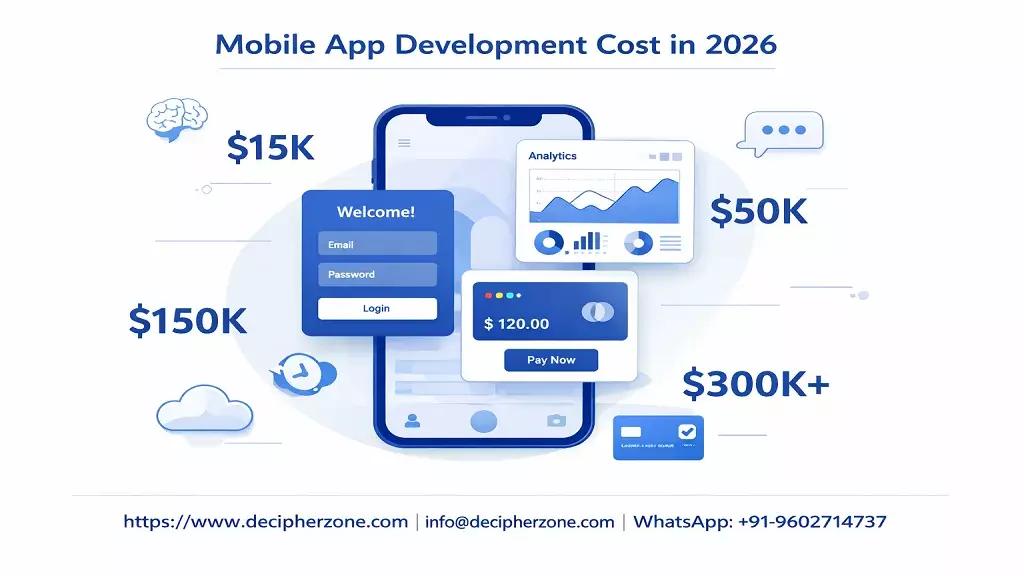
Mobile app development costs between $15,000 and $400,000+ in 2026, depending on complexity, platform, features, and where your development team is based. A simple MVP on a single platform runs $15,000 to $40,000. A mid-complexity app with payments, real-time features, and analytics runs $60,000 to $150,000. Enterprise-grade platforms with AI, multi-role systems, and complex integrations run $200,000 to $400,000 or more. Add 15 to 25% of the build cost annually for maintenance, updates, and infrastructure.
Key takeaways:
- App complexity is the primary cost driver: moving from mid-level to advanced typically multiplies total cost by 2 to 3 times.
- Cross-platform frameworks like Flutter and React Native reduce development cost by 30 to 50% compared to building two separate native apps.
- An MVP-first approach consistently saves 30 to 40% on total project cost by validating the product before scaling features.
- India-based development at $25 to $49 per hour delivers 60 to 70% cost savings compared to US or UK agencies at $100 to $200 per hour, with no compromise on output quality when the partner has the right process and communication discipline.
- The global mobile application market was valued at $252.89 billion in 2023 and is projected to reach $626.39 billion by 2030, growing at over 14% annually (Grand View Research). The case for building is stronger than ever.
- Decipher Zone has delivered mobile applications for clients in the US, UAE, Saudi Arabia, and Europe since 2012, with senior engineers at $25 to $49 per hour. Get a transparent cost estimate for your project.
From on-demand delivery to fintech wallets and AI-powered healthcare solutions, apps have become central to how businesses generate revenue, retain customers, and scale operations.
The first question every founder, CTO, and product head asks is the same one: how much does it actually cost to build a mobile app in 2026?
The problem is not a shortage of answers. It is a shortage of honest ones. Most cost guides give you a range so wide it tells you nothing useful. This guide gives you specific numbers, sourced from real project data, broken down by complexity tier, platform choice, app type, development phase, and region. You will leave with enough information to build a realistic budget, evaluate a vendor quote, and avoid the scope changes that blow up timelines and costs.
Read: Software Development Guide | 13 Biggest Challenges in Mobile App Development
Mobile App Development Cost by Complexity Tier
The simplest way to estimate your app cost is to place it in one of three complexity tiers. These ranges reflect 2026 market rates for a skilled offshore team at $25 to $49 per hour, which is the cost model that most US, European, and Gulf companies use when working with India-based development partners.
| Complexity Tier | What it includes | Platforms | Dev Hours | Offshore Cost | US/UK Cost | Timeline |
|---|---|---|---|---|---|---|
| Simple MVP | 8 to 10 screens, login and auth, basic CRUD, static content | Single (iOS or Android) | 450 to 650 hrs | $15,000 to $40,000 | $60,000 to $120,000 | 2 to 3 months |
| Mid-Complexity | Payments, push notifications, chat, analytics, admin dashboard, third-party APIs | iOS and Android (cross-platform) | 900 to 1,300 hrs | $40,000 to $80,000 | $120,000 to $220,000 | 4 to 7 months |
| Complex App | Real-time features, AI/ML, multi-role architecture, custom backend, compliance, advanced security | iOS and Android plus backend | 1,800 to 3,000 hrs | $80,000 to $200,000 | $250,000 to $450,000 | 7 to 12 months |
| Enterprise Platform | Multiple user roles, legacy system integrations, ERP/CRM sync, regulatory compliance, custom AI models | All platforms plus web | 3,000 to 6,000+ hrs | $150,000 to $400,000+ | $400,000 to $900,000+ | 10 to 18 months |
The jump from mid-complexity to complex is not linear. Based on project data from across the industry, moving from a mid-tier to an advanced app typically multiplies total cost by 2 to 3 times. That multiplication comes from real-time backend architecture, compliance overhead, AI model training and integration, and the dramatically larger QA surface area that comes with multi-role systems.
The Cost Formula Every Budget Should Start With
The most transparent way to understand app cost is the formula that all serious development firms use internally:
Total Cost = Estimated Development Hours × Blended Hourly Rate
Where blended hourly rate accounts for the mix of seniority levels on the project: senior engineers, mid-level developers, QA engineers, and project managers do not all bill at the same rate. A project with a senior architect and mid-level developers blended together might average $35 per hour where the senior engineer individually bills at $49.
This formula is useful not just for building your own estimate but for evaluating a vendor quote. If a vendor quotes $50,000 for an app but cannot tell you how many hours that estimate is based on, ask them. A well-run development firm can tell you within a few hours how many engineering hours your spec requires, broken down by role. If they cannot, the quote is guesswork.
Case Study: Cerebrum UPSC Exam Prep App
Our team built Cerebrum, a UPSC exam preparation app, as a lean Flutter-based MVP. The initial version included only essential test-taking features and came in at the lower end of the Simple MVP range. As we scaled to include retake options, Firebase real-time sync, and performance dashboards, development hours grew substantially.

A feature that took 40 hours in the MVP phase required 80 to 100 hours to integrate cleanly into the scaled product because of the additional data model complexity and the existing architecture that needed to accommodate it. Starting lean and scaling deliberately is almost always cheaper than building everything at once.

What a $50,000, $150,000, and $300,000 App Actually Looks Like in 2026
Abstract cost ranges become clearer when you attach them to concrete product descriptions. Here is what each major budget tier realistically buys you from a quality offshore team in 2026.
$50,000: A validated MVP with a clear commercial purpose
At $50,000 with an offshore team at $30 to $40 per hour, you get approximately 1,200 to 1,600 development hours. That is enough to build a cross-platform app using Flutter or React Native with: user authentication and profile management, a core feature set of 4 to 6 primary flows, basic payment processing through Stripe or Razorpay, push notification capability, a lightweight admin dashboard, and basic analytics integration.
You are not getting AI features, complex real-time data, or multi-role architecture at this budget. But you are getting something shippable that real users can pay for and respond to. This is the right budget to validate that your idea has a market before committing to the next phase.
$150,000: A production-grade app ready to compete in a real market
At $150,000, you have 3,000 to 4,500 development hours at a blended offshore rate of $33 to $50 per hour. This budget covers a complete cross-platform app with full native-grade UX, real-time messaging or live data, sophisticated payment flows including subscription management, a full admin and reporting system, third-party API integrations across 4 to 8 services, push notification personalization, security hardening, and a thorough QA process including automated testing.
This is where most well-funded startup apps land after their first proper build cycle. If your market research is solid and you know what your users need, this budget produces an app you can run a business on.
$300,000: A platform, not just an app
At $300,000, you are building something with multiple stakeholder groups (customer-facing, provider-facing, admin-facing), significant backend complexity, probably a compliance requirement of some kind (HIPAA, PCI-DSS, GDPR, or regional equivalents), AI-powered features with meaningful training data pipelines, and the architectural foundations to scale to millions of users without a complete rebuild.
This is where fintech platforms, enterprise healthcare apps, complex on-demand marketplaces, and multi-sided platforms land. The development timeline is 10 to 14 months with a full team of 6 to 10 people.
Mobile App Development Cost by Platform
Your platform decision shapes your budget from day one and continues to affect costs through maintenance, updates, and feature releases for the entire life of the product.
| Platform | Cost Range | Best for | Trade-off |
|---|---|---|---|
| Android only | $20,000 to $200,000 | Markets where Android dominates: India, Southeast Asia, Africa, Latin America | Misses iOS users in US, Europe, GCC markets where iPhone adoption is higher |
| iOS only | $25,000 to $220,000 | US, UK, Australia, UAE premium consumer apps where iOS share is 50%+ | Misses the majority of global smartphone users who are on Android |
| Cross-platform (Flutter or React Native) | $30,000 to $250,000 | Most startups and SMBs who need both platforms without doubling the budget | Hardware-intensive features (AR, complex camera, Bluetooth) require native modules |
| Native iOS and Android (two codebases) | $60,000 to $400,000+ | Apps where platform-specific UX, performance, or hardware access is truly critical | Highest cost and longest timeline; maintenance requires two parallel updates |
For most businesses in 2026, cross-platform development is the right starting point. Flutter and React Native have matured to the point where 90% of use cases produce an experience indistinguishable from native.
The 10% where native clearly matters involves heavy camera processing, AR features, complex Bluetooth or IoT device interaction, and certain gaming scenarios. If your app does not fall into one of those categories, choosing cross-platform from the start saves 30 to 50% on initial build cost and an equivalent saving on every future update cycle.
Read: Flutter vs React Native: Full Comparison | Android App Development Guide | iOS App Development Guide
Flutter vs React Native: Cost Comparison
| Factor | Flutter | React Native |
|---|---|---|
| Language | Dart | JavaScript / TypeScript |
| Relative build cost | Slightly lower: single rendering engine, fewer platform-specific adjustments | Comparable; larger talent pool can reduce hiring cost |
| Performance | Excellent: compiled to native ARM, no JavaScript bridge | Good: improved markedly with the New Architecture in 2024 |
| UI consistency | Pixel-perfect across platforms: Flutter renders its own widgets | Slightly different per platform; uses native UI components |
| Talent availability | Growing fast, especially in India and Eastern Europe | Larger global pool; easier to hire quickly |
| Best for | MVPs, apps where consistent UI matters, fintech, healthtech | Apps where native feel per platform is important, teams already in JS |
| Maintenance cost | Lower: one codebase, fewer platform-specific bugs | Slightly higher due to bridge dependencies and native module maintenance |
Case Study: Focused Trading Advisory App (React Native)
We built Focused Trading, a US-based advisory and brokerage platform, using React Native. The framework allowed simultaneous iOS and Android delivery, which was critical given the client's launch timeline.
The analytical dashboard, secure Spring Boot backend, and financial data integrations added significant project hours beyond what the cross-platform framework saved on the frontend.
This is the pattern we see consistently: the framework choice affects frontend cost, but complex backend logic, security architecture, and third-party financial data integrations are not cheaper regardless of which mobile framework sits above them.

Mobile App Development Cost by App Type and Vertical
The type of app you are building changes the cost range within any given complexity tier. Compliance requirements, data security obligations, real-time infrastructure needs, and domain-specific complexity all push costs higher in certain verticals.
| App Type | Cost Range | What drives cost up |
|---|---|---|
| eCommerce / Marketplace | $40,000 to $200,000 | Multi-vendor logic, inventory sync, payment processing, recommendation engine |
| On-Demand Delivery | $60,000 to $250,000 | Three-sided app (user, provider, admin), real-time GPS tracking, dynamic pricing |
| Fintech / Wallet / Investment | $80,000 to $350,000 | PCI-DSS compliance, KYC/AML integration, bank API connections, fraud detection |
| Healthcare / Telemedicine | $80,000 to $300,000 | HIPAA compliance (US), data residency requirements, video consultation, EHR integration |
| Social / Community | $50,000 to $200,000 | Real-time messaging, content moderation, media handling, recommendation algorithms |
| EdTech / eLearning | $40,000 to $180,000 | Video streaming, assessment engine, progress tracking, offline content delivery |
| AI-Powered App | $80,000 to $400,000+ | Model training data, inference infrastructure, fine-tuning, API cost at scale |
| Enterprise / Internal Tool | $60,000 to $300,000 | Legacy system integrations, role-based access, audit logging, SSO/LDAP |
| IoT-Connected App | $70,000 to $250,000 | Device protocol support, firmware update management, telemetry data pipelines |
Read: Enterprise Application Development Guide | Types of Mobile App Development
Phase-by-Phase Cost Breakdown: Where Your Budget Actually Goes
One of the most useful things a budget planner can understand is not just the total cost but how that cost is distributed across the development lifecycle. The phase allocations below reflect typical distributions from professional development engagements.
| Development Phase | % of Total Budget | What happens here | Cost for $100K project |
|---|---|---|---|
| Discovery and Planning | 10 to 15% | Requirements workshops, user journey mapping, tech stack selection, sprint planning, architecture design | $10,000 to $15,000 |
| UI/UX Design | 15 to 20% | Wireframes, visual design, design system creation, prototype, user testing, design handoff | $15,000 to $20,000 |
| Frontend Development | 25 to 30% | Screen implementation, state management, animations, API integration on the client side | $25,000 to $30,000 |
| Backend and API Development | 20 to 25% | Database schema, API design and build, authentication, third-party integrations, business logic | $20,000 to $25,000 |
| QA and Testing | 10 to 15% | Manual and automated testing, regression, performance testing, security testing, device coverage | $10,000 to $15,000 |
| Deployment and Launch | 5 to 10% | App store submission, server configuration, CI/CD setup, monitoring, launch support | $5,000 to $10,000 |
The discovery phase is the one that most budget-constrained teams skip or compress, and it is consistently the decision that costs the most money later. Projects that begin development without a clearly documented specification, validated user journeys, and agreed technical architecture spend 20 to 40% more during development fixing decisions that should have been made during planning.
AI as a Cost Factor in 2026: What It Adds and What It Saves
AI has become one of the most important variables in mobile app budgeting for 2026. It works in both directions simultaneously.

Where AI adds cost
Building a truly AI-native feature, not just calling an API and displaying the output, but training a model on your specific data, integrating inference into the app's UX in a way that feels natural, and managing the ongoing cost of running that inference at scale, adds $20,000 to $80,000 to a typical project depending on complexity.
Custom recommendation engines, fraud detection models, and computer vision features all require specialized ML engineering work that general mobile developers cannot do.
Where AI reduces cost
AI-assisted development tools compress delivery time on routine tasks. GitHub Copilot, Cursor, and similar tools reduce boilerplate writing time by 20 to 35% on typical projects. This benefit is already priced into competitive market rates from good offshore teams.
It does not mean you should expect a 30% price reduction when asking a vendor about AI tooling. It means you should expect that a vendor using these tools produces more output per hour than one that does not, which should translate into fewer hours for equivalent scope.

.avif)
The AI API cost hidden in your infrastructure budget
If your app calls OpenAI, Anthropic, or Google Gemini APIs in production, those API costs scale with usage. An app making 10,000 calls per day to a GPT-4o class model at current pricing spends $150 to $400 per month on inference alone at low usage. At 100,000 daily calls, this becomes a significant operating cost line item that belongs in your financial model from day one.
Developer Hourly Rates by Region (2026 Corrected Data)
These rates reflect blended averages for senior-to-mid level mobile app developers at established agencies and consultancies in 2026, sourced from Clutch, GoodFirms, and Upwork benchmarks.
They represent the rates professional agencies charge clients, not the salaries paid to individual engineers.
| Region | Blended Hourly Rate | Cost: Mid-Complexity App (1,200 hrs) | Key advantage |
|---|---|---|---|
| India and South Asia | $20 to $50/hr | $24,000 to $60,000 | Largest talent pool, mature delivery processes, strong English, 10 to 12.5 hr overlap with US East Coast |
| Southeast Asia | $25 to $55/hr | $30,000 to $66,000 | Strong mobile development talent, growing tech hubs in Vietnam and the Philippines |
| Eastern Europe | $35 to $75/hr | $42,000 to $90,000 | EU time zone overlap, strong technical education, experienced with international enterprise clients |
| Latin America | $35 to $75/hr | $42,000 to $90,000 | US time zone alignment enables real-time collaboration, growing React Native and Flutter talent base |
| GCC and UAE | $60 to $120/hr | $72,000 to $144,000 | Strong regional compliance knowledge (PDPL, UAE data law), local presence |
| Western Europe | $80 to $160/hr | $96,000 to $192,000 | GDPR expertise, onshore presence, strong design culture |
| North America (US and Canada) | $100 to $200/hr | $120,000 to $240,000 | Onshore, same time zone, high availability for in-person collaboration |
The quality gap between the best India-based mobile development teams and US-based teams is smaller than the cost gap. The variables that actually determine quality are process maturity, communication discipline, code review standards, and testing culture.
All of these can be verified during the vendor selection process regardless of geography. Read our guide on in-house vs outsourcing app development to understand what the decision really involves.

Hidden Costs Every Budget Must Account For
1. App maintenance and updates: 15 to 25% of build cost annually
Once your app is live, iOS and Android release major OS updates roughly twice a year and minor updates continuously. Each one can break functionality that was working perfectly the day before. Your payment SDK may deprecate an API method. Your camera integration may require changes for new iOS permission frameworks. Your push notification delivery may change with a new Android background process policy.
A fintech startup in Dubai built a mobile wallet for approximately $80,000. Within the first year, they spent an additional $18,000 on mandatory iOS and Android compatibility updates, bug fixes, and scaling their cloud infrastructure when user traffic doubled during a campaign. That is 22.5% of the original build cost, right in the middle of the industry benchmark range.
Budget 15 to 25% of your original build cost per year for maintenance. For a $100,000 app, that is $15,000 to $25,000 annually. This is not optional spend. It is the cost of keeping your app functional, secure, and available in the app stores.
Read: Application Maintenance Services Guide

2. Third-party APIs and services: recurring costs that compound with scale
Modern apps depend on external services that each carry their own pricing. These costs are manageable at launch and can become significant at scale.
- Stripe payments: 2.9% plus $0.30 per transaction. On $100,000 in monthly payment volume, that is $3,200 per month going to Stripe before you count other costs.
- Google Maps API: $7 per 1,000 map loads and $5 per 1,000 directions requests. A delivery app making 50,000 route calls per month pays $250 to $350 just for maps.
- Chat and video SDKs: Sendbird and Twilio scale from $400 to $2,000 per month as active users grow past the free tier thresholds.
- Push notification services: OneSignal and Firebase Cloud Messaging are free at low volumes but enterprise plans run $99 to $999 per month.
- Authentication services: Auth0 and Clerk have generous free tiers that disappear quickly once your user base grows past 7,000 to 10,000 monthly active users.
Build a complete API cost model before you finalize your financial projections. The services that seem free during development often become meaningful line items by month six of production.
3. App Store Optimization: not optional if you want organic discovery
Launching an app without ASO is releasing a product into a category with two million competitors and doing nothing to help users find it. Apple's Product Page Optimization allows A/B testing of icons, screenshots, and preview videos.
Google Play's Store Listing Experiments do the same. Apps with optimized listings consistently achieve 20 to 30% higher conversion rates from store page visits to installs, which reduces your paid acquisition cost for every user you do attract through advertising.
A health-tracking app tested two icon designs using Apple's Product Page Optimization and found the new design improved install conversion by 18%, generating thousands of additional downloads per month without spending more on advertising. The tool cost was $69 per month. The return was a sustained reduction in cost per install across all paid channels.
ASO tool budgets: AppTweak and App Radar run $69 to $299 per month depending on the plan. Consider this ongoing cost when budgeting for the first 12 months post-launch.
4. Security and compliance: cheaper now than catastrophic later
Regulatory compliance in apps serving the US, EU, GCC, or any regulated vertical is a fixed cost that you can pay during development or pay as fines and remediation after a breach or audit finding.
- HIPAA violations in the US run up to $50,000 per violation and $1.5 million per year for repeated violations of the same requirement.
- GDPR fines can reach 4% of global annual revenue. For a company doing $10 million annually, that is $400,000 for a single compliance failure.
- PDPL (Saudi Arabia) and UAE data law carry similar enforcement frameworks that are being actively enforced from 2024 onward.
A fintech startup in Europe that invested $12,000 upfront in GDPR audit, MFA integration, and penetration testing avoided the kind of exposure that has fined comparable companies millions. Building compliance into your architecture from the start costs $10,000 to $40,000 depending on the regulatory framework. Retrofitting it after a finding typically costs 3 to 5 times more.
Case Study: Woopers Business B2B Finance App
We built Woopers Business, a B2B supply chain financing platform using Flutter. Features like KYC verification, secure payment communications, and real-time receivables management added approximately 25% more development and QA hours compared to a typical B2B app of equivalent visible complexity.
The compliance work is largely invisible to end users but completely determinative of whether the app can legally operate in its target market. Any fintech or enterprise app budget that does not include a specific compliance cost line item is underestimated by 20 to 35%.
5. Infrastructure and hosting: the ongoing cost of running a live product
Cloud infrastructure is not a one-time cost. It scales with usage, and usage patterns are difficult to predict before launch.
- Basic app (low traffic): $50 to $200 per month on AWS, GCP, or Azure for a simple backend with modest storage and compute.
- Mid-scale app (10,000 to 50,000 MAU): $300 to $1,500 per month depending on database size, media storage, and API call volume.
- High-traffic app (100,000+ MAU): $2,000 to $10,000+ per month, with significant variance based on whether you have optimized your database queries, CDN usage, and compute allocation.
Infrastructure costs that are not planned for in advance become surprises that require emergency budget approval. Build a usage-based infrastructure cost model during the architecture phase.
6. Marketing and user acquisition: the cost of actually getting users
The best app fails commercially if no one discovers it. Marketing budget should be calculated as a separate line item, not as an afterthought after development concludes.
- Google Ads and Apple Search Ads: $0.80 to $5.00 per install depending on niche and targeting.
- Meta Ads (Facebook and Instagram): $1.00 to $4.00 per install for consumer apps in competitive categories.
- Micro-influencer partnerships: $500 to $2,000 per post on Instagram or YouTube, with conversion to installs varying by audience match.
- Content marketing and social media management: $2,000 to $5,000 per month for a basic ongoing programme.
A food delivery startup spent $12,000 on TikTok advertising in the first three months, acquiring 30,000 installs at $0.40 per install. A US fitness app partnered with five micro-influencers at $500 to $2,000 per post, generating 5,000 targeted installs in the first month.
These numbers vary by category, competition, and targeting quality. The consistent finding across consumer apps is that marketing spend in year one can equal 50 to 100% of the initial development cost for apps that need significant user acquisition to achieve network effects.
.jpeg)
The MVP-First Strategy: How to Save 30 to 40% on Total Project Cost
Companies that adopt an MVP-first approach combined with iterative scaling consistently achieve faster time-to-market and 30 to 40% lower total cost over a 24-month product cycle compared to those that attempt to build full-featured products from the start.
The reason is not that MVPs are cheap versions of real products. It is that features built before you understand how users behave are often the wrong features. An MVP forces you to identify the single most valuable thing your app does and build only that.
The features that survive user testing and real-world usage data are far cheaper to scale properly than features that were assumed valuable during planning and had to be rebuilt when they proved wrong.
For most founders, the right MVP question is not "what is the minimum version of my full vision?" but "what is the smallest product that lets a real user accomplish the thing they would pay for?" Those are different questions and they produce very different scopes.
Read: MVP Development Cost: Australia vs Offshore
When Building an App Is Not the Right Decision
Not every business problem requires a custom-built app, and the most commercially honest thing a development company can tell you is when you should not build one yet.
A custom app is not the right next step when: your core business process is not yet stable or well-understood, you have not spoken to more than 20 potential users about the problem the app would solve, your projected user volume in year one does not justify the infrastructure cost of maintaining a live app, a no-code or low-code tool like Bubble, Adalo, or a Shopify plugin would serve 80% of your immediate need, or you are building primarily to have something impressive to show investors rather than to solve a user problem.
A well-run no-code MVP built in 4 to 6 weeks for $5,000 to $15,000 that gets in front of real users is more valuable to a founder's decision-making than a $120,000 custom app built to a spec that was written without user validation. If user testing on the no-code version confirms the core concept, you build the custom version with much higher confidence in what you are building.

Build vs Buy vs Hybrid: The Strategic Decision Behind Every App Budget
The choice of how to build shapes the total cost more than any individual feature decision. There are three realistic options in 2026.
Build from scratch
Full custom development gives you complete control over UX, architecture, and feature roadmap. It costs the most upfront and takes the longest, but produces no vendor dependency and no licensing cost. This is the right choice when your app IS the product, when it contains genuine competitive differentiation in the software itself, or when your integration requirements are too specific for any existing platform.
Buy and configure
SaaS platforms, white-label solutions, and app builders let you launch in weeks for a fraction of the custom cost. A Shopify store with a companion app via the Shopify mobile SDK, a Bubble-built marketplace, or a white-label telemedicine platform all deliver fast time-to-market.
The trade-off is that you are on the vendor's roadmap. When you need a feature the platform does not support, you are blocked until they build it or until you pay for a custom integration that is often more expensive than starting from scratch would have been.
Hybrid
Build a custom core for the functions that differentiate your product and buy SaaS tools for everything else. The custom user experience and core business logic sits in your codebase.
The authentication, email marketing, analytics, customer support, and payment processing run on established SaaS tools. This is the dominant approach for well-funded startups in 2026 because it combines control over competitive differentiation with speed and cost efficiency for commoditized functions.
Total Cost of Ownership: Budgeting for the Full Product Lifecycle
The initial build cost is not the cost of your app. It is the cost of your app's first version. Budgeting for the complete two-year lifecycle of a mid-complexity mobile app at $100,000 initial build looks like this.
| Cost Category | Year 1 | Year 2 | 2-Year Total |
|---|---|---|---|
| Initial build | $100,000 | $0 | $100,000 |
| Maintenance and updates (20%) | $20,000 | $20,000 | $40,000 |
| Infrastructure (cloud hosting) | $3,600 | $7,200 | $10,800 |
| Third-party API services | $4,800 | $9,600 | $14,400 |
| Feature development (phase 2) | $0 | $30,000 | $30,000 |
| ASO and marketing | $24,000 | $18,000 | $42,000 |
| Total cost of ownership | $152,400 | $84,800 | $237,200 |
A $100,000 app costs $237,000 over its first two years of active operation. Founders who plan for only the initial build and discover the rest in real time consistently face cash flow crises in months 8 to 14.
Planning for the full lifecycle cost from the outset is the single most important thing that separates app projects that survive to product-market fit from those that run out of runway before getting there.
How to Get an Accurate App Development Quote
Most vendor quotes are not wrong because of dishonesty. They are wrong because both the client and the vendor are working from different levels of scope specificity. Here is how to get a quote that is actually reliable.
Document your scope before approaching vendors
A product requirements document with user stories, screen-by-screen flows, and clearly described features gives every vendor the same inputs. Without this, each vendor makes different assumptions and their quotes are not comparable.
Ask for a breakdown by development phase and role
Any vendor who can give you a total number but cannot tell you how many hours of backend development versus frontend versus QA versus project management that total represents is quoting from a template rather than from your specific requirements.
Ask how they handle scope changes
id-project changes are inevitable. A vendor who prices changes at a consistent hourly rate with a written change order process is predictable. A vendor who says scope changes are "included" in the quote has built a buffer that you paid for upfront and may not need, or has not thought through the cost implications.
Check references for similar project types
A fintech app reference from a vendor is more relevant than a general ecommerce app reference when you are building a fintech platform. Compliance, security architecture, and banking API integration experience are specific and verifiable.
Decipher Zone begins every engagement with a two-week technical discovery phase that produces a complete specification, architecture diagram, and sprint plan with hour allocations by role before any development begins. You see exactly what you are getting, when, and what it costs before a line of code is written. Contact us for a transparent project estimate or hire our mobile development team directly.

Frequently Asked Questions: Mobile App Development Cost in 2026
How much does it cost to build a mobile app in 2026?
Mobile app development in 2026 costs $15,000 to $400,000+ depending on complexity, platform choice, app type, and development team location. A simple MVP built offshore on a single platform starts at $15,000 to $40,000 with a timeline of 2 to 3 months. A mid-complexity app with payments, chat, analytics, and cross-platform delivery runs $40,000 to $150,000 over 4 to 7 months. Enterprise platforms with AI, multi-role systems, compliance requirements, and complex integrations run $200,000 to $400,000+ over 10 to 18 months. Add 15 to 25% of the build cost annually for maintenance and updates.
How long does it take to develop a mobile app?
Simple MVPs take 2 to 3 months from discovery to app store launch. Mid-complexity apps with payments, real-time features, and analytics take 4 to 7 months. Complex apps with AI, multi-role architecture, and compliance requirements take 7 to 12 months. Enterprise platforms take 10 to 18 months. These timelines include discovery and planning (2 to 4 weeks), design, development, QA, and deployment. Projects that compress or skip the discovery phase consistently take longer in total because of rework that good planning would have prevented.
What is the difference in cost between iOS, Android, and cross-platform apps?
Building for a single platform (iOS only or Android only) is the cheapest option, ranging from $20,000 to $220,000 depending on complexity. Cross-platform development using Flutter or React Native costs 10 to 20% more than a single native build but delivers both iOS and Android apps, making it 30 to 50% cheaper than building two separate native apps. Two fully native apps (one iOS, one Android) costs the most: $60,000 to $400,000+, but delivers the best platform-specific UX and hardware access. For most businesses in 2026, cross-platform is the right starting point unless your app depends on hardware features that require native code.
How much does it cost to maintain a mobile app after launch?
Expect to spend 15 to 25% of your original development cost annually on maintenance and updates. A $100,000 app costs $15,000 to $25,000 per year to maintain. This covers OS compatibility updates for iOS and Android major and minor releases, bug fixes identified post-launch, security patches, SDK and library updates, and performance optimization as your user base grows. Apps that are not actively maintained fall out of compliance with app store policies, stop working after major OS updates, and become security liabilities. Maintenance is not optional spend: it is the cost of keeping a live product operational.
Does AI reduce mobile app development costs in 2026?
AI development tools reduce costs on specific task types but not on total project scope. Tools like GitHub Copilot and Cursor reduce boilerplate writing time by 20 to 35% on routine development tasks, which is already factored into market rates at quality offshore firms. However, AI features within an app add cost, not reduce it. Adding a custom recommendation engine, computer vision feature, or AI-powered chatbot that goes beyond a basic API call adds $20,000 to $80,000 depending on complexity. AI API costs in production also scale with usage and can become a significant ongoing infrastructure cost. The net effect of AI in 2026 is that apps are expected to do more, which keeps total budgets from falling even as hourly rates soften slightly.
How much does cross-platform app development cost compared to native?
A cross-platform app built with Flutter or React Native costs 30 to 50% less than building two separate native apps for iOS and Android. For a mid-complexity app that would cost $150,000 as two native builds, the Flutter or React Native equivalent runs $80,000 to $105,000. The quality difference in 2026 is minimal for most use cases: both frameworks have matured to produce native-grade performance and UX for the vast majority of app categories. The scenarios where native is worth the extra cost are those involving heavy hardware access (AR, complex camera, IoT Bluetooth), GPU-intensive graphics, or platform-specific features that require deep OS integration.
How much does it cost to build an MVP?
A genuine MVP, meaning the minimum product that lets real users accomplish the core task and give you meaningful feedback, costs $15,000 to $60,000 depending on platform and feature set. This assumes a single platform (or cross-platform with Flutter), 6 to 10 screens, core authentication, the one to three features that define your value proposition, basic data storage, and app store submission. Features like push notifications, advanced analytics, admin dashboards, and payment processing are often left out of the MVP and added in phase two based on user feedback. Teams that use an MVP-first approach save 30 to 40% on total 24-month project cost compared to those that try to build the full product from the start.
What is the cheapest way to build a mobile app in 2026?
The four most effective cost-reduction strategies in order of impact are: first, start with a single-platform MVP rather than building for iOS and Android simultaneously; second, use a cross-platform framework (Flutter or React Native) rather than two native codebases when you do need both platforms; third, work with an offshore development team in India or Southeast Asia at $25 to $50 per hour rather than US or European agencies at $100 to $200 per hour; fourth, use existing SaaS tools for authentication, payments, email, and analytics rather than building these from scratch. Combining all four strategies can reduce a $150,000 project to $40,000 to $60,000 without reducing the user-facing value of what gets built.
Can Decipher Zone build a mobile app within my budget?
Yes. Decipher Zone builds mobile applications for clients in the US, UAE, Saudi Arabia, and Europe using Flutter, React Native, iOS, and Android native development. Our senior engineers bill at $25 to $49 per hour, which positions us as a high-quality offshore option that is 60 to 70% cheaper than US or UK agencies for equivalent technical output. We have built apps for fintech clients including Woopers Business (B2B supply chain finance), exam preparation platforms like Cerebrum, and advisory platforms like Focused Trading. Every engagement starts with a two-week paid discovery phase that produces a full specification and sprint plan before development begins. Contact us or hire our development team directly.
Author Profile: Mahipal Nehra is the Digital Marketing Manager at Decipher Zone Technologies, specialising in content strategy and tech-driven marketing for software development and digital transformation. He works closely with Decipher Zone's mobile and web development teams to produce practical guidance for founders, CTOs, and product leaders evaluating development partnerships.
Follow on LinkedIn or explore more insights at Decipher Zone.
Cost data in this guide is based on 2026 market benchmarks from Clutch, GoodFirms, and Upwork developer rate surveys. Estimates reflect blended rates from professional agencies and may vary based on specific project requirements, team composition, and geographic location.